Balcones Runoff and Austin Water Damage Restoration: A Study
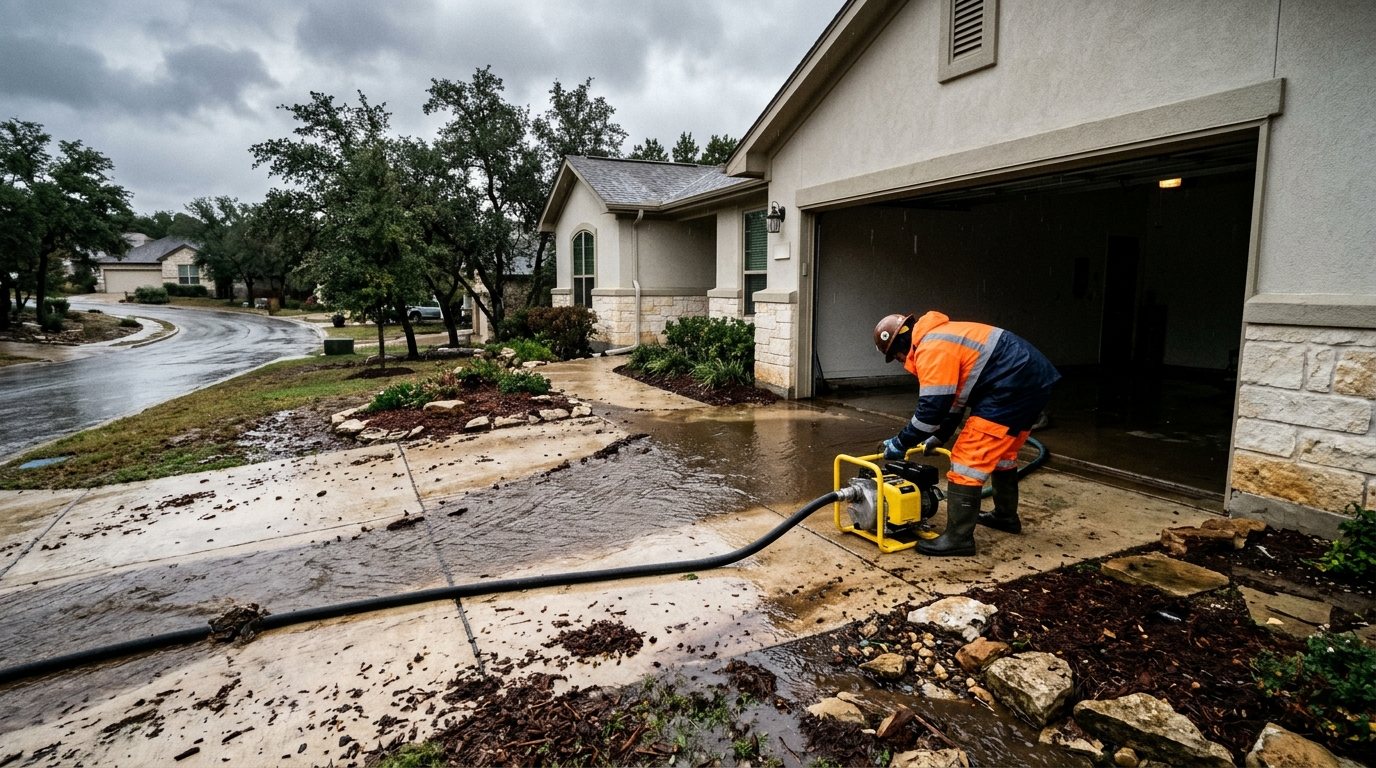
Runoff along the Balcones Fault zone generates severe overland velocity and sudden hydraulic loading against residential foundations during Central Texas flash storm events. Saturated Edwards limestone shelves reject deep surface infiltration, forcing turbulent stormwater through weep tracks, slab seams, and masonry perimeters. Mitigating this intrusion requires immediate mass water extraction, psychrometric vapor pressure depression, and systematic thermal monitoring to stabilize permeable residential assemblies across Austin.
Keywords: Balcones Escarpment, Edwards limestone, psychrometrics, structural drying, Austin, flood mitigation.
1. Balcones Escarpment Hydrology and Runoff Dynamics
The geologic boundary of the Balcones Fault marks a sharp topographical division where the Edwards Plateau meets the Blackland Prairie. During high-intensity convective storms in Travis County, rainfall precipitation rates frequently exceed four inches per hour. Because the weathered Edwards limestone bedrock lies immediately beneath shallow caliche topsoils, subterranean absorption reaches total saturation within minutes. The resulting overland sheet flow cascades downslope through neighborhoods flanking Shoal Creek, Barton Creek, and Bull Creek. As surface velocities accelerate, residential structures encounter dynamic hydrostatic forces capable of overcoming conventional exterior waterproofing barriers.
Urban development along these slope corridors alters native drainage paths. Reinforced concrete drives, paved arterial corridors, and compact retaining walls divert torrential stormwater directly toward slab perimeters. Austin homeowners situated in low-lying alluvial basins face sudden foundation submersion where perimeter drainage swales overflow. The mechanical interaction between saturated caliche clay and dense limestone creates subterranean perched aquifers that exert persistent lateral pressure against subterranean foundation walls long after surface downpours abate.
2. Hydrostatic Pressure and Infiltration Mechanisms
Hydrostatic head pressure increases by approximately 0.433 pounds per square inch for every vertical foot of standing water against a foundation perimeter. When surface runoff pools against brick veneer or masonry facades above the foundation slab elevation, water penetrates through exterior weep holes and porous mortar beds. Capillary action draws liquid through concrete micropores, transmitting moisture horizontally across living area floor assemblies. Flooring systems, including glued engineered oak, laminate, and carpet cushion, absorb liquid rapidly, generating substantial vapor gradients inside enclosed wall cavities.
Once moisture breaches the building envelope, secondary structural saturation develops inside interior partition walls. Conventional gypsum drywall draws water upward through capillary suction up to twenty-four inches above the finished floorline within forty-eight hours. Sill plates anchored to concrete footings absorb water through cellular fiber saturation, elevating framing moisture content well above the twenty percent threshold required for subterranean wood-decay fungal spores to germinate. Saturated fiberglass batt insulation loses its thermal loft, slumping inside cavity framing while holding trapped water against structural studs.
3. Worked Psychrometric Sizing and Evaporation Equations
Successful structural drying requires precise control of environmental vapor pressure differentials between saturated building materials and ambient indoor air. Consider an impacted Austin residence with a main living zone measuring sixty feet by forty feet with ten-foot ceilings, yielding a total indoor volume of 24,000 cubic feet. Initial field psychrometric assessment reveals an indoor ambient temperature of 82 degrees Fahrenheit and a relative humidity of 75 percent. Consulting a standard psychrometric chart determines the ambient humidity ratio at 124 grains of moisture per pound of dry air (GPP), corresponding to an ambient vapor pressure of 0.82 inches of mercury (inHg).
To establish an effective evaporative gradient from saturated lumber into indoor air, technicians must depress the ambient indoor humidity ratio down to 34 GPP, achieved by maintaining drying chamber conditions at 72 degrees Fahrenheit and 30 percent relative humidity. This establishes an ambient vapor pressure of 0.23 inHg. Saturated wood framing containing 28 percent moisture content at 72 degrees Fahrenheit exhibits an internal material vapor pressure of 0.79 inHg. The resulting vapor pressure differential of 0.56 inHg (0.79 inHg minus 0.23 inHg) drives continuous, rapid evaporation from bound cellular structures into the treatment air mass.
Dehumidifier equipment sizing follows standardized volumetric formulas for Class 3 water losses involving ceiling, wall, and subfloor saturation. For an indoor space of 24,000 cubic feet under Class 3 conditions using modern low-grain refrigerant (LGR) dehumidification units, the calculation divides the room volume by an industry divisor of 30, requiring an initial dehumidification capacity of 800 pints per twenty-four-hour period at AHAM test conditions (80 degrees Fahrenheit and 60 percent relative humidity). This demand is satisfied by deploying six commercial LGR units rated at 135 pints per day, paired with twenty-four high-velocity centrifugal air movers delivering laminar airflow along structural base plates at twelve-foot intervals.
| Stage | Temperature (F) | Relative Humidity | Humidity Ratio (GPP) | Vapor Pressure (inHg) |
|---|---|---|---|---|
| Initial Inspection | 82.0 | 75% | 124.0 | 0.82 |
| Extraction Completion | 78.5 | 62% | 91.5 | 0.61 |
| Active Evaporation Day 2 | 74.0 | 42% | 53.2 | 0.36 |
| Stabilized Target Day 4 | 72.0 | 30% | 34.1 | 0.23 |
4. IICRC S500 Categorization and Contamination Profiles
Under the IICRC S500 Standard for Professional Water Damage Restoration, water intrusions are stratified into three distinct contamination categories based on source purity and biological hazard potential. Flash flood runoff originating from the Balcones Escarpment that crosses roadways, gardens, and urban storm corridors carries dissolved minerals, silt, pathogenic bacteria, and chemical residues. Consequently, exterior storm runoff that enters an Austin property is classified strictly as Category 3 blackwater.
Category 3 classification dictates stringent remediation protocols. Porous structural materials directly contacted by overland blackwater, including carpet padding, gypsum board, fibrous duct liners, and fiberglass batt insulation, cannot be restored through simple surface drying. These assemblies must be excised, sealed in heavy poly containment bags, and removed to eliminate pathogenic amplification. Non-porous concrete slabs and semi-porous framing lumber can be salvaged provided technicians perform thorough mechanical detergent cleaning, hot-water pressure rinsing, and application of registered broad-spectrum antimicrobial solutions prior to structural drying operations.
5. Texas Administrative Rules and Regulatory Timelines
Residential property restoration within the state of Texas operates under distinct statutory provisions enforced by the Texas Department of Insurance and the Texas Department of State Health Services. Under the Texas Insurance Code, property owners must provide prompt written notification of flood and water losses to their primary insurers. In situations where standing water persists beyond seventy-two hours, fungal spore germination frequently triggers the provisions of the Texas Mold Assessment and Remediation Rules (TMARR, 25 TAC 295 Subchapter G).
TMARR mandates that whenever visible fungal amplification covers more than twenty-five contiguous square feet of surface area within an indoor property, remediation must follow formal protocol preparation by a licensed independent Mold Assessment Consultant (MAC). A licensed Mold Remediation Contractor (MRC) must execute the physical work, and the consultant must conduct post-remediation clearance testing before issuing a formal Certificate of Mold Damage Remediation (Form MDR-1). Engaging qualified professionals such as this Austin restoration team ensures mitigation steps comply strictly with state administrative rules while safeguarding structural integrity.
American Red Cross. (2026). Disaster Relief and Flood Safety Preparedness Standards. Washington, DC. Retrieved from American Red Cross emergency flood recovery guidance.
6. Six-Stage Structural Drying Protocol
Field technicians addressing Balcones flood surges implement a rigorous six-stage scientific drying framework to reverse structural saturation efficiently1:
- Hazard Isolation and Moisture Mapping: Technicians inspect the building envelope using thermal imaging cameras and non-penetrating radio-frequency moisture meters to establish baseline perimeter moisture maps without puncturing intact vapor seals.
- Bulk Water Extraction: High-volume submersible pumps remove pooled subterranean water, followed by weighted industrial extraction mats deployed across horizontal concrete slabs to remove free water before vapor diffusion occurs.
- Sanitary Controlled Demolition: Gypsum wallboard is removed using precision horizontal flood cuts twelve to twenty-four inches above the high-water waterline to expose damp wall cavities and accelerate air circulation.
- Antimicrobial Application: Structural framing studs receive pressurized applications of botanical or quaternary ammonium antimicrobial sanitizers to halt microbial germination and eliminate surface pathogens.
- Thermodynamic Chamber Control: Technicians seal exterior windows and exterior door openings, installing industrial LGR dehumidifiers and axial air movers directed at forty-five-degree angles toward framing members to sustain continuous moisture evaporation.
- Psychrometric Monitoring and Final Clearance: Daily temperature, relative humidity, and pin-type wood moisture equivalent (WME) readings are recorded until all structural lumber measures below twelve percent equilibrium moisture content.
Professional water damage restoration ensures that subterranean limestone runoff does not lead to chronic dry rot or structural frame deterioration across Austin properties.
Austin Hydrologic Questions
How does Edwards limestone topography accelerate residential water intrusion?
Edwards limestone features fractured karst channels and shallow soil caps that prevent deep percolation. Heavy storm bursts rapidly pool on the surface and flow downhill toward residential perimeters rather than dispersing into the soil.
Why must Balcones storm runoff be treated strictly as Category 3 blackwater?
Surface runoff across suburban streets collects pet waste, motor oil, agricultural runoff, and bacterial pathogens. When floodwaters enter residential basements or living quarters, they present severe health risks that mandate complete excision of porous building assemblies.
What psychrometric grain depression is required for effective structural drying?
Technicians aim to depress indoor humidity ratios below forty grains per pound (GPP) while keeping ambient temperatures near seventy-two degrees Fahrenheit. This depression creates the steep vapor pressure differential necessary to draw deep moisture out of saturated framing lumber.
When does Texas administrative law require a Certificate of Mold Damage Remediation?
Under Texas administrative code TMARR, if water damage restoration is delayed and mold amplification exceeds twenty-five contiguous square feet, a certified mold assessor must inspect the property and issue an official MDR-1 certificate following successful remediation clearance.
- Calculated using standardized empirical psychrometric constants for Class 3 structural losses over dense masonry foundations.